Intro to Foil
Intro to Épée
Intro to Saber
-
What Is Fencing?
The United States Fencing Association provides the following information about fencing.
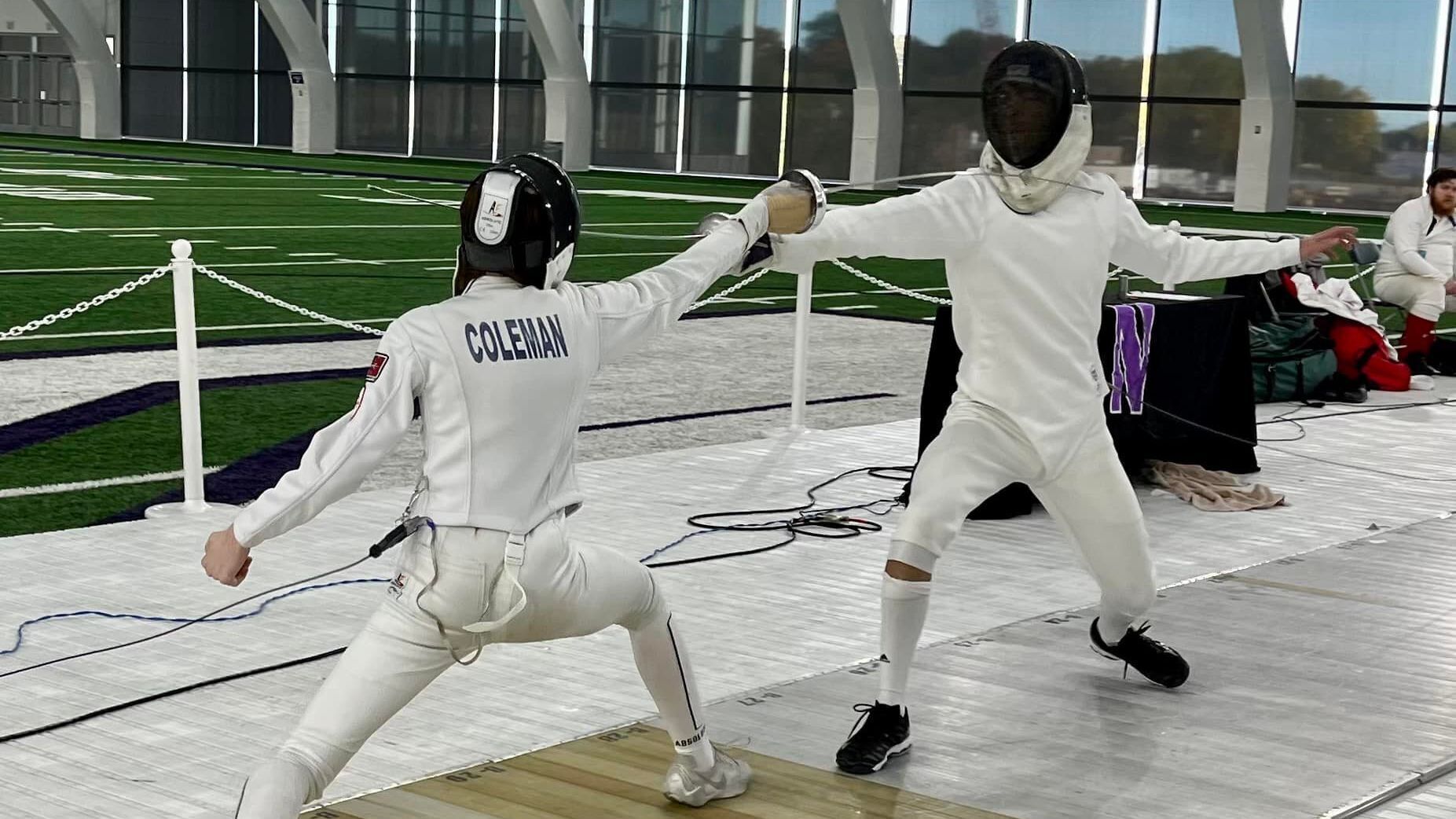
The sport of fencing is fast and athletic, a far cry from the choreographed bouts you see on film or on the stage. Instead of swinging from a chandelier or leaping from balconies, you will see two fencers dancing back and forth on a 5ft x 45ft strip. The movement is so fast, the touches are scored electronically.
-
The Weapons
Foil, épée, and saber are the three weapons used in the sport of fencing. While it is not unusual for fencers to compete in all three events, they generally choose to develop their skills in one weapon.
Foil and épée are point-thrusting weapons. Saber is a point-thrusting, as well as, a cutting weapon. The target areas differ for the three weapons, though all three are scored electronically.
-
The Objective of Fencing
The goal of a fencing bout (that's what an individual "game" is called) is to score 15 points (in direct elimination play) or 5 points (in preliminary pool play) before your opponent can do the same or time expires. Each time a fencer scores a touch, they receive a point.
Points are received by making a touch in the opponent's target area. Direct elimination matches in épée and foil consist of three 3-minute periods with a 1-minute break between each. In saber, the first period lasts for 8 points, followed by a 1-minute break, then the second period ends when one of the fencers scores 15 points.
-
Foil
The foil has a flexible, rectangular blade approximately 35 inches in length and weighs less than one pound. Points are scored with the tip of the blade.
The valid target area in foil is the torso, from the shoulders to the groin, front and back. It does not include the arms, neck, head, or legs. The foil fencer’s uniform includes a metallic vest (called a lamé (pronounced "LUH-may")) that covers the valid target area, so that a valid touch will register on the scoring machine. A small, spring-loaded tip is attached to the point of the foil and is connected to a wire inside the blade. The fencer wears a body cord under their jacket that connects the foil to a reel wire, which connects to the scoring machine.
-
Épée
The épée (pronounced “EPP-pay”), the descendant of the dueling sword, is similar in length to the foil but is heavier, weighing approximately 27 ounces, with a larger guard (to protect the hand from a valid hit) and a much stiffer blade. Touches are scored only with the point of the blade. The entire body is valid target area.
The blade is wired with a spring-loaded tip at the end that completes an electronic circuit when it is depressed beyond a force of 750 grams. This causes the colored light on the scoring machine to illuminate. Because the entire body is valid target area, the épée fencer’s uniform does not include a lamé. Off-target hits do not register on the machine.
-
Saber
The saber is the modern version of the slashing cavalry sword and is similar in length and weight to the foil. The major difference is that the saber is a cutting weapon, as well as a thrusting weapon; fencers may score a valid touch with the edge of the blade. The target area is from the bend of the hips (both front and back) to the top of the head, simulating the cavalry rider on a horse. Like foil, saber fencers wear a metallic jacket (lamé) that covers the target area to register a valid touch on the scoring machine. Since the head is valid target area, the mask is made with conductive material on the outside.
-
Right-of-Way
One of the most difficult concepts to visualize in foil and saber fencing is the rule of right-of-way. This rule was established to eliminate apparently simultaneous attacks by two fencers.
In essence, right-of-way is the differentiation of offense and defense made by the referee. The difference is important only when both fencers’ lights go on at the same time in foil and saber. When this happens, the winner of the point is the one who the referee determined was on offense at the time the lights went on.
Épée does not use the right-of-way in keeping with its dueling origin — whoever first gains the touch earns the point. Or, if both fencers hit within 40 milliseconds of each other, both earn a point.
-
How to Follow the Action
For those new to fencing, it is difficult to follow the lightning speed of the fencers’ actions. To become more comfortable in watching a fencing bout, focus on one fencer. The fencer being attacked defends themselves by use of a parry (a motion used to deflect the opponent’s blade) after which the defender can make a riposte (an answering attack). Thus, the two adversaries keep changing between offense and defense. Whenever a hit is made, the referee will stop the bout, describe the actions, and decide whether or not to award a touch.
Fencers seek to maintain a safe distance from each other — that is, out of range of each other’s attack. Then, one will try to break this distance to gain the advantage for an attack. At times, a fencer will make a false attack to gauge the opponent’s reactions.
As you become accustomed to the speed of the game, the tactics and strategies will become more apparent, and you will gain a better understanding for the finesse and fascination of fencing!
-
How to Interpret the Scoring Box
There are three types of scoring lights on the machine. A green light shows when the right fencer hits valid target, and a red light shows when the left fencer hits valid target. In épée and saber, off-target hits do not register on the machine. In foil, a touch landing outside the valid target area (area that isn't covered by the lamé) is indicated by a white light. These off-target hits do not count in the scoring, but they do stop the fencing action temporarily.
In fencing, a "lockout" on a scoring box refers to a brief period of time after one fencer registers a touch, during which the system won't register another touch from either fencer, essentially preventing simultaneous hits from being scored; this time period varies depending on the fencing weapon, with saber having the longest lockout time compared to foil and épée, allowing for a more dynamic exchange of attacks.